
Top Solutions for Building Crypto and Fiat Payment Flows
Crypto and stablecoins now power real payment flows. Payroll systems use them. Cross-border settlements depend on them. Treasury teams move significant value through them daily. These are not experiments anymore. Businesses actively integrate these rails into core financial operations. Transaction volumes keep growing, but infrastructure complexity grows right alongside.
The main challenge is fragmentation. Different providers handle different layers: onboarding, payouts, custody, and processing. Nobody connects everything out of the box. You assemble your own stack rather than buy a single solution. That takes time and creates hidden failure points. The platforms below solve different parts of this puzzle.
How Crypto and Fiat Payment Flows Work in Practice
Modern payment systems stack multiple layers. You need an on-ramp to get money in. Off-ramp to get money out. Payout rails to send funds. Custody to hold assets safely. Settlement to clear transactions. Processing to accept payments. These layers must work together in real time.
No single provider covers everything effectively. Different business models need different tool combinations. Pick the wrong layer for your use case, and the whole workflow breaks. Each platform below fits a specific role. Know your role before you choose.
1. Paybis Ltd
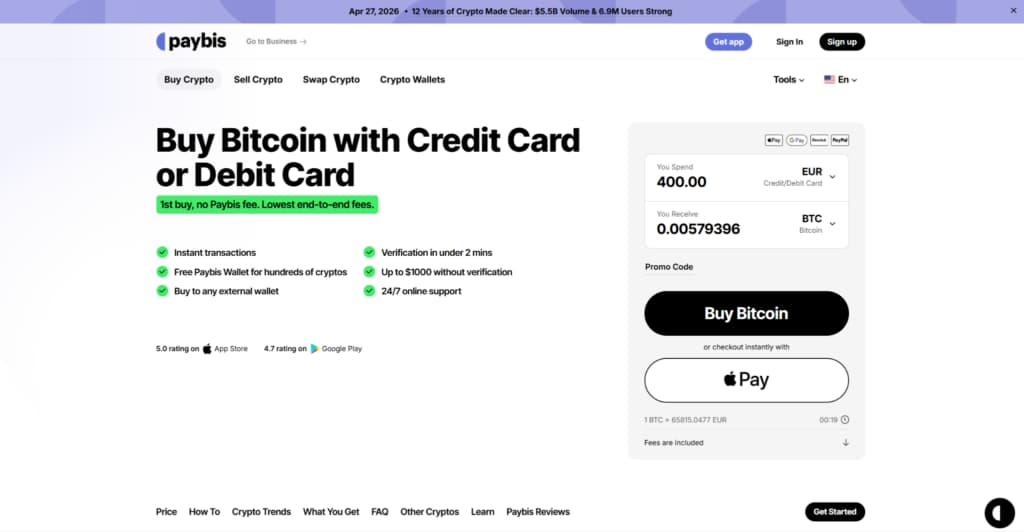
Paybis operates as a full-stack crypto payment infrastructure provider for businesses working with both crypto and fiat flows. The platform combines on-ramp, off-ramp, payouts, payment processing, and wallet-as-a-service within one system. You don’t need five different vendors to handle onboarding, settlement, and fund movement. Global coverage spans 180+ countries and 48 US states, making it usable across different markets.
Full Infrastructure and Financial Flow Management
Most businesses end up stitching multiple providers together to cover all functions. That increases integration complexity and introduces new failure points. Reconciliation becomes a nightmare when money moves across three platforms before settling. Paybis reduces this by consolidating infrastructure into a single layer.
Key platform functions include:
- Fiat-to-crypto and crypto-to-fiat on-off-ramp infrastructure;
- Global crypto and fiat payouts via API and dashboard;
- Support for payment processing and crypto acquiring;
- White-label wallets and embedded financial flows;
- Coverage across multiple regions, currencies, and payment methods.
Paybis fits businesses that need a unified infrastructure layer rather than a patchwork of point solutions.
2. Ramp Network

Ramp focuses specifically on fiat-to-crypto onboarding. The platform is developer-friendly, with clean APIs and SDKs that make integration relatively fast. Instead of building custom flows, teams can plug in Ramp and launch onboarding with minimal effort. It is widely used by Web3 apps and wallets where conversion and user acquisition matter most. The user experience is smooth and reduces friction at the entry point. Transaction processing remains stable even under higher load.
On-Ramp Experience and Developer Integration
Onboarding quality directly affects conversion rates. Bad UX kills user acquisition. Ramp prioritizes simplicity and speed. The integration path is straightforward, and the documentation actually helps.
Platform strengths include:
- Fiat-to-crypto onboarding with strong user experience;
- Developer-friendly APIs and SDKs;
- Fast integration with minimal setup time;
- Reliable transaction processing under load;
- Integration with wallets and Web3 platforms.
Ramp works best for products where user onboarding is the primary use case.
3. Transak
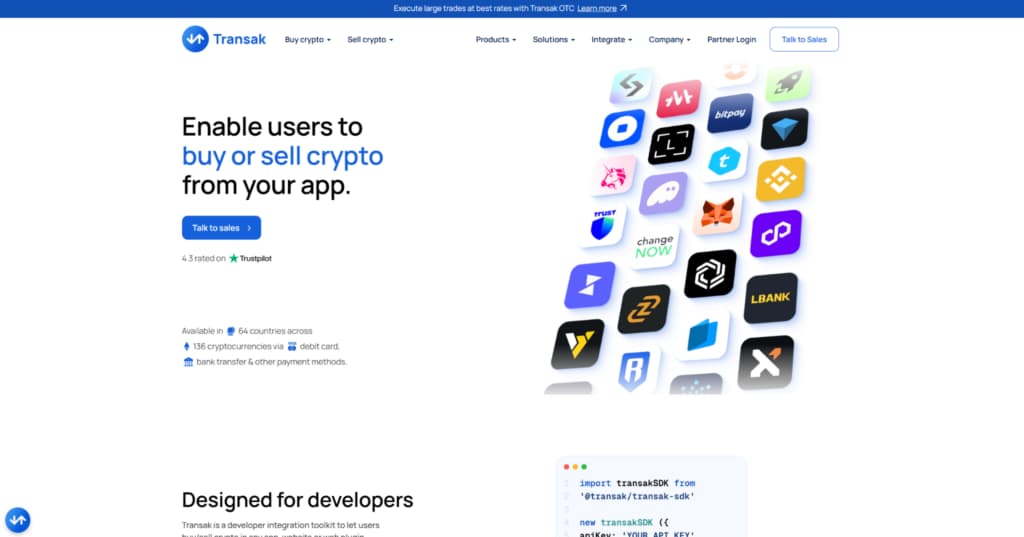
Transak provides global on-ramp and off-ramp infrastructure with a strong focus on local payment methods. The platform supports users across multiple regions, including markets where traditional payment options are limited. It has a solid presence in emerging markets where many competitors have weaker coverage. Localization improves conversion rates, and Transak builds its flows around regional preferences. This makes it a practical choice for businesses expanding across different geographies.
Global Coverage and Local Payment Access
Global expansion requires local payment support. Credit cards don’t work everywhere. Regional methods like PIX, SEPA, and M-Pesa matter. Transak handles the complexity of regional compliance and settlement so you don’t have to.
Main capabilities include:
- Global on-ramp and off-ramp infrastructure;
- Support for local payment methods across regions;
- Strong presence in emerging markets;
- Compliance handling across multiple jurisdictions;
- Integration with Web3 platforms and wallets.
For global or multi-region businesses, Transak covers ground that competitors miss.
4. Coinbase Commerce

Coinbase Commerce lets businesses accept crypto without getting deep into how it all works under the hood. You plug it into your store, and payments in crypto just start going through like any other method. It works with platforms like Shopify, so you’re not rebuilding checkout from scratch. There’s no need to manage wallets, nodes, or anything техническое на стороне бизнеса. For most teams, it feels like adding one more payment option, not rolling out a whole new system.
Crypto Payment Acceptance for Merchants
Merchants need checkout solutions that just work. They don’t want to manage blockchain infrastructure or volatility risk. Coinbase Commerce handles the complexity behind a simple interface.
Core functions include:
- Crypto payment acceptance for merchants;
- Integration with e-commerce platforms;
- Support for major cryptocurrencies and stablecoins;
- Simple setup without technical complexity;
- Transaction tracking and reporting tools.
Coinbase Commerce fits straightforward payment use cases where simplicity matters more than customization.
5. Banxa
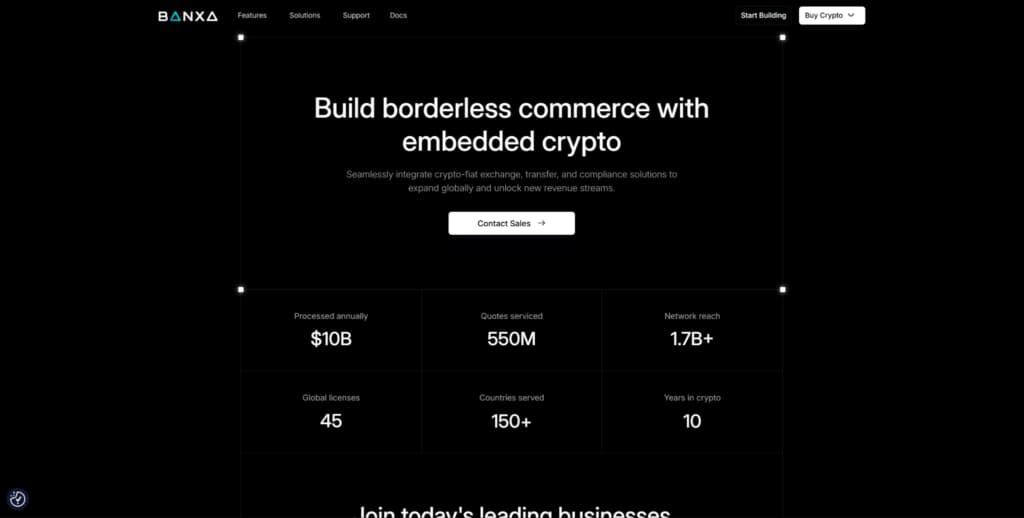
Banxa operates a fiat-to-crypto gateway built around compliance and regulatory alignment. The platform is designed for businesses operating in jurisdictions with strict oversight. It focuses on secure onboarding with KYC and AML processes embedded directly into the flow. This helps reduce risk when scaling payment operations across regulated markets. For companies that need to meet compliance requirements from day one, Banxa provides a structured and predictable setup.
Compliance-Driven On-Ramp Infrastructure
Compliance becomes critical when scaling payment systems. Regulators pay attention to crypto flows. Banxa builds its infrastructure around KYC, AML, and regional licensing requirements.
Primary features include:
- Fiat-to-crypto gateway infrastructure;
- Strong compliance and regulatory alignment;
- Support for multiple payment methods;
- Global coverage across regulated markets;
- Integration with fintech and Web3 platforms.
Banxa is best for compliance-heavy environments where regulatory risk cannot be ignored.
How to Choose the Right Platform
Your business model decides which platform fits. A consumer app needs a different infrastructure than an enterprise treasury desk. Map your actual payment flows before looking at feature lists. The wrong choice creates integration debt.
Multiple factors impact performance and scalability. Infrastructure beyond feature checklists matters more than you think.
When evaluating infrastructure, focus on:
- Business model and use case requirements;
- Geographic coverage and payment methods needed;
- Integration complexity and available technical resources;
- Compliance and regulatory requirements in your markets;
- Scalability and transaction volume expectations.
The right choice simplifies scaling and reduces operational risk. The wrong choice hides costs until it’s too late.
Final Thoughts
Crypto and fiat payments don’t run on a single platform. They’re built from separate layers that need to work together without breaking under real volume. Most teams end up combining a few providers, whether they planned to or not. That’s not a flaw, it’s just how the market is structured right now. What actually matters is how your payment flow behaves in production, not how clean it looks on paper. If the system handles real transactions without friction, you’re using the right stack.