
Top 5 Retail Execution and Field Sales Tools for CPG Teams
A common issue for CPG field teams is that shelf auditing tools and order entry tools are usually separate. Merchandisers record out-of-stocks and planogram issues in one application. Then another person must communicate that information so a sales representative can manually enter the order into a different system. This process creates delays, introduces errors, and reduces revenue.
Retail execution software and field sales tools grew up on separate paths. The first group excels at in-store audits and compliance tracking. The second focuses on capturing orders, planning routes, and handling invoices. Teams that need both capabilities often buy and maintain two platforms, or they try to patch things together with emails and spreadsheets.
We compared five solid options for the CPG market. Each takes its own approach to combining these functions. The breakdown covers workflow integration, offline performance, pricing, and the specific scenarios where each tool really shines.
What to Look for
Selecting retail execution software for your CPG team comes down to workflow fit, not feature volume. Before vendor demos, measure your team’s actual operations against five key criteria.
1. Audit-to-Order Continuity
The highest cost in the CPG field operations is the gap between problem detection (e.g., out-of-stock) and order placement. Most audit tools lack integrated ordering, forcing reps to switch applications or use manual communication.
Instead, deploy one platform that allows a rep to photograph a shelf violation and immediately generate a replenishment order without leaving the screen.
2. Offline-First Architecture
Your reps work in grocery backrooms, rural convenience stores, and warehouse coolers—not corporate boardrooms with perfect WiFi. If a tool requires constant connectivity, your data accuracy will suffer.
Prioritize mobile-first platforms with full offline capability:
- The app must log audits,
- Capture photos,
- Record orders without signal,
- Auto-sync when connectivity returns.
3. DSD and Route Accounting Support (if applicable)
For brands handling direct store delivery or van sales, a retail execution tool alone is insufficient. You need native route planning, delivery proof capture, invoicing, and settlement workflows.
Verify whether the tool handles the full order-to-cash cycle—from shelf audit to order to delivery to QuickBooks/ERP sync—or whether you’ll need a separate DSD system.
4. Pricing Model and Lock-In
Beware of audit-only tools with low sticker prices but hidden user minimums, and enterprise suites with long annual contracts. Choose transparent per-rep monthly billing, no forced annual deals, and a free trial with real training—not just a demo.
5. Integration Simplicity
Don’t accept middleware or custom APIs. Prioritize platforms with native two‑way syncs to your ERP and eCommerce system. If a captured order doesn’t automatically turn into an invoice, you haven’t fixed your workflow—you’ve just relocated the bottleneck.
Top 5 Tools
CPG teams should consider these five platforms for retail execution. They differ in approach to auditing, orders, and distribution—from SMB solutions to enterprise suites. Choose based on team size, region, and need for audit-to-order continuity.
SimplyDepo
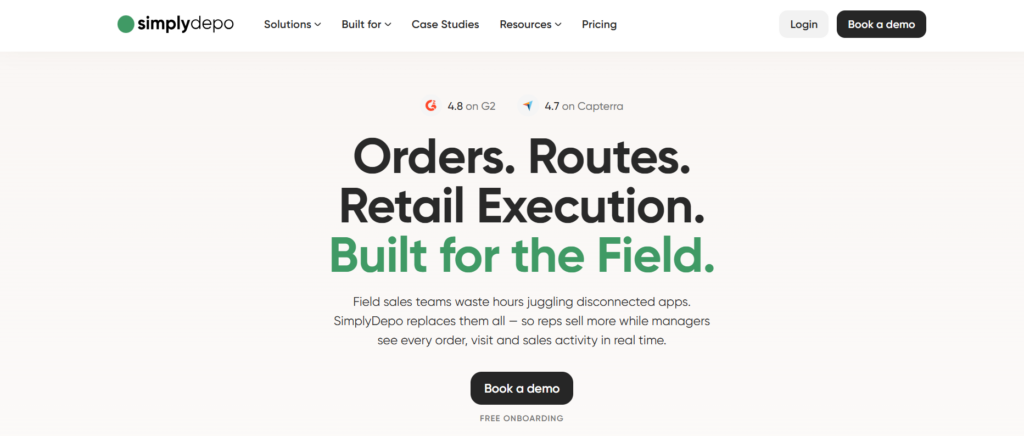
SimplyDepo is a mobile-first retail execution software built for CPG brands and distributors, combining shelf audits, planogram compliance, photo reporting, in-store demos, and visit tracking with field sales order capture, DSD route planning, van sales, invoicing, and native QuickBooks and Shopify sync.
It is purpose-built for SMB and mid-market teams of 1 to 100 reps, merchandisers, and route drivers across the US and Canada. Pricing starts at $89 per rep per month with simple monthly billing, no annual contracts, no setup fees, and a 30-day free trial that includes free team training, with implementation completed in days.
Unlike audit-only tools or enterprise B2B suites, SimplyDepo closes the loop so the same rep who audits a shelf can capture the reorder, plan the route, run the delivery, and sync to accounting in one offline-capable app.
Pros
What sets SimplyDepo apart is how it combines retail execution, field sales, and direct store delivery into one clean mobile app. Reps can finish an audit and place an order on the spot, which removes the usual delays and reduces errors from switching between systems.
On the business side, it’s quite affordable at $89 per rep monthly with no long contracts or setup fees. You can try it risk-free for 30 days. It works well offline and has solid built-in integrations with QuickBooks and Shopify, so data moves automatically without complicated add-ons.
Cons
The platform is currently available only in the US and Canada. It doesn’t support multi-region, multi-currency, or multi-language setups needed for EMEA or APAC operations.
It’s not ideal for companies that only want heavy compliance auditing or third-party merchandising without order management. Since it’s built around field activity, pure eCommerce or remote sales teams probably won’t get full value from it.
Who Should Still Choose SimplyDepo
SimplyDepo works really well for SMB and mid-market CPG brands and distributors in the US or Canada that depend on regular in-store visits. It’s especially useful for teams that want to combine shelf audits, order capture, and delivery workflows inside one simple system.
It stands out in these situations:
- Companies looking to replace several tools (audit app, order app, and spreadsheets) with one mobile workflow.
- Teams that want to avoid enterprise-level pricing and lengthy implementations.
- Groups with 1 to 100 reps, merchandisers, and route drivers.
Repsly
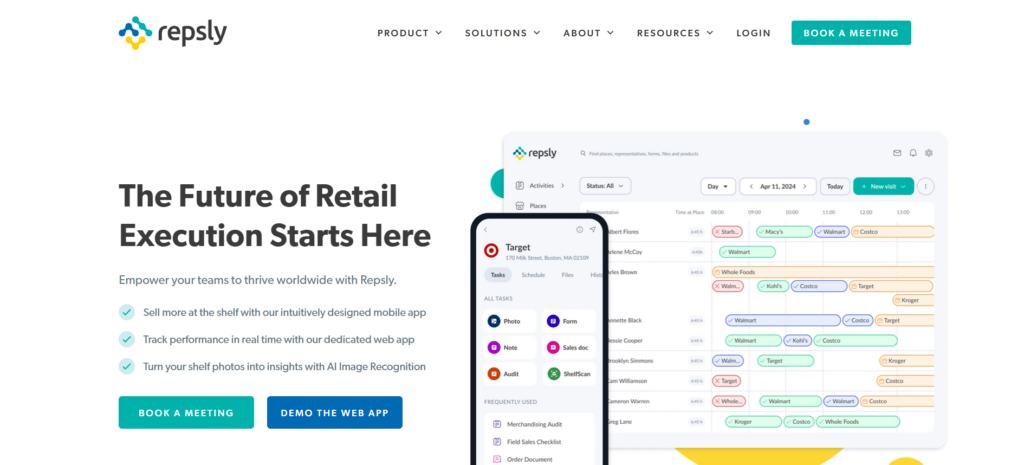
Repsly serves CPG brands and merchandising teams by giving them better visibility into store conditions. Field reps use it to gather structured data on every visit and turn that information into practical insights they can actually act on.
It performs especially well with shelf audits, planogram compliance, stock availability tracking, competitor checks, and promotion execution. Their ShelfScan AI stands out here — it analyzes shelf photos to spot products and measure compliance, which significantly reduces manual reporting while improving overall accuracy.
It also includes field management tools like visit tracking, territory optimization, and task assignment, plus web dashboards for managers. While it offers basic order and return tracking, it doesn’t support full order-to-cash or DSD processes. Repsly is best suited for mid-sized to large CPG companies that prioritize retail execution over integrated sales tools.
Pros
Repsly offers a strong retail execution and merchandising focus with extensive shelf audit capabilities. Its AI image recognition technology automates shelf photo analysis and compliance checks, saving manual reporting time.
Cons
Integrations with third-party reporting tools are restricted, which can make it harder to get a full view of operations. The backend and reporting features are sometimes described as not very intuitive or limited in depth. Users also mention occasional sync and performance issues, and constant GPS tracking can drain the device battery quickly. (Capterra reviews)
Who Should Still Choose Repsly
Repsly is a strong fit for mid-sized and enterprise CPG companies that care more about retail execution and in-store visibility than sales or distribution workflows. Teams that focus heavily on shelf audits, planogram compliance, and photo-based reporting will find it closely matches what they need.
It works especially well in these cases:
- Teams that work with merchandising agencies.
- When audit accuracy and in-store insights are more important than order capture or DSD integration.
- Organizations that are comfortable using a separate system for order management.
Skynamo
Skynamo serves manufacturers, wholesalers, distributors, and importers who need better control over their field and B2B sales processes. It focuses on helping sales teams build customer relationships, take orders efficiently, and coordinate activities across channels.
You get a practical mobile app for field reps alongside inside sales tools and a customer self-service portal. Salespeople can easily manage their visits, pull up catalogs, and close orders on the go, while customers order directly through a branded online portal.
The platform also delivers clear analytics, reporting, and real-time visibility for the whole team. Its Radar AI feature adds another layer by highlighting important trends in sales data. Although it supports some retail execution, Skynamo’s main focus is on streamlining sales workflows and order processing. It tends to work best for companies running complex B2B operations, especially across Europe, the Middle East, and Africa.
Pros
Skynamo provides a strong field sales and order-taking platform suitable for manufacturers, wholesalers, distributors, and importers with multiple sales channels. It supports multi-currency and multi-region operations, particularly in EMEA and APAC.
Cons
However, it depends on clean data to deliver accurate results, which requires extra effort. Reporting can be limited in depth, especially for detailed sales tracking. Connectivity issues may affect syncing in low-signal areas, and consistent usage from reps is needed. Some users also note that it can be relatively expensive. (G2 reviews)
Who Should Still Choose Skynamo
Skynamo is a solid choice for international B2B sales teams working across multiple countries and channels. It’s particularly useful for manufacturers, wholesalers, and distributors who want field sales, order entry, and customer portals combined in one platform.
Here’s where it fits best:
- Companies based outside North America need reliable multi-currency and multi-region features.
- Teams that don’t need heavy retail execution capabilities.
- Organizations that prioritize smooth order capture and multi-channel operations over in-store audits.
Pepperi
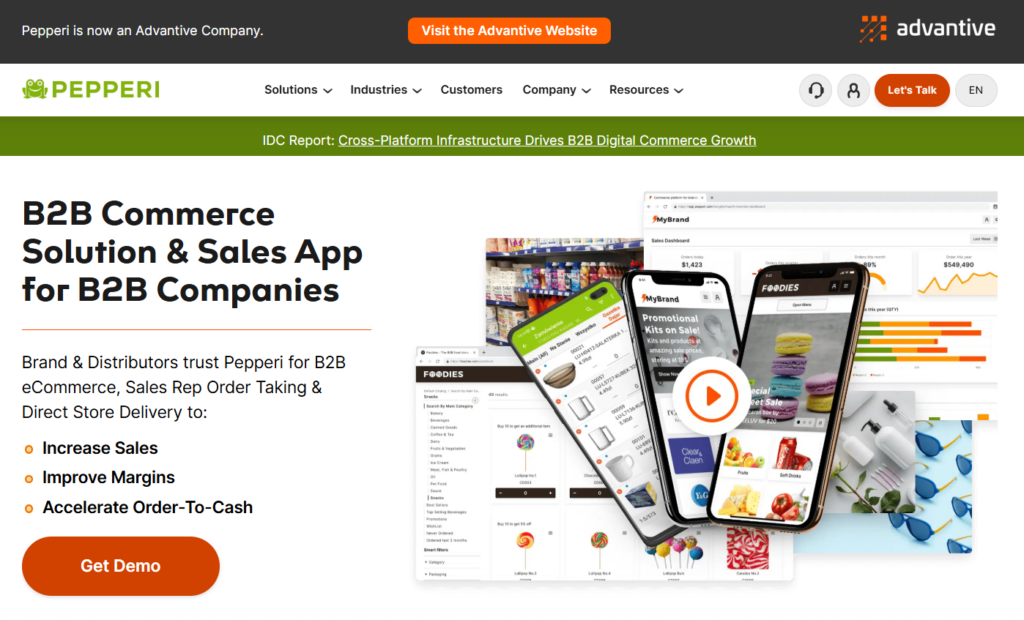
Pepperi combines eCommerce, field sales, order management, and retail execution in a single B2B commerce platform. It targets brands and wholesale distributors that need end-to-end control over their sales process.
Features include online customer portals, field order capture, direct store delivery, and route accounting. Extra modules cover trade promotions, mobile CRM, and customer support to manage the order-to-cash cycle.
It includes some in-store merchandising and tracking features, though these are not the main emphasis. Pepperi is commonly used in food & beverage, FMCG, health & beauty, and wholesale distribution. Mid-sized and enterprise teams often choose it when they want a scalable all-in-one tool, accepting longer setup times and higher costs in return.
Pros
Pepperi offers a broad B2B commerce platform with eCommerce, field sales, DSD, route accounting, CRM, and retail execution all in one system. It provides strong ERP integration support for complex back-office environments.
Cons
Based on Capterra reviews, Pepperi has a higher cost compared to SMB-focused tools. It requires setup support or partner involvement for implementation, and users have reported customer support and billing issues.
Who Should Still Choose Pepperi
Pepperi is a good fit for mid-sized and larger distributors that want a full B2B commerce ecosystem in one place. Companies with tricky ERP setups, operations spread across regions, or complicated sales structures tend to benefit most from its wide range of features.
It stands out in these scenarios:
- Managing the entire order-to-cash cycle across multiple sales channels.
- Teams that can accept higher pricing and longer setup periods.
- Businesses needing eCommerce, field sales, and direct store delivery combined in a single platform.
GoSpotCheck (FORM)
These days, GoSpotCheck operates under FORM. It’s a practical mobile tool designed for frontline workers who need structured visits and instant oversight from leadership. You’ll see it used in CPG, retail, hospitality, and facility management settings.
The software helps teams manage tasks, collect data, and maintain compliance. Reps can perform audits, surveys, photos, and workflows across locations. PhotoWorks AI scans images to extract shelf placement, compliance, and quality data, reducing time and human error.
Teams can customize their own task flows, while managers monitor progress through clean, real-time dashboards. Keep in mind it focuses more on execution and coordination than on sales orders or distribution. This makes it especially appealing to mid-sized and enterprise teams that need reliable compliance and better control over dispersed field operations.
Pros
GoSpotCheck is easy to use for field audits, offering strong task management, photo reporting, and image recognition features. Its workflow builder allows teams to customize task flows based on operational needs.
Cons
However, there are a few limitations. It may not work with all device types, which can require companies to standardize hardware across teams. Some organizations may need to provide compatible devices for full functionality. Additionally, while it is strong for audits and task management, it is primarily focused on execution workflows rather than broader sales or order management processes. (Capterra reviews)
Who Should Still Choose GoSpotCheck (FORM)
GoSpotCheck is a solid choice for businesses that want structured task management and smooth audit processes across their distributed teams. Organizations that lean heavily on checklists, surveys, and compliance work tend to get a lot of value from its flexibility.
It performs especially well in these situations:
- When your teams don’t require order capture or delivery management tools.
- Retail, hospitality, and facilities management environments.
- Companies that prioritize operational visibility and standardized execution above everything else.
It’s a strong match if daily field coordination and consistency are your biggest needs.
Conclusion
No single tool fits every CPG model. The right choice depends on whether your workflow starts with an audit, an order, or a delivery route.
Pick an all-in-one platform if you need unified audits, orders, and DSD. Choose audit-first tools if shelf compliance trumps order management. Go with field sales platforms for multi-channel international teams. Accept enterprise suites only if you need full B2B commerce and have a budget for longer timelines. Use compliance-only solutions for task management without orders.
Before committing, run a side-by-side pilot. Test offline, measure audit-to-order time, and verify native accounting sync. The tool that closes the gap between seeing a problem and solving it delivers the fastest payback.