
Top 5 Salesforce NetSuite Integration Tools That Actually Work Without Breaking
Everyone builds an integration between Salesforce and NetSuite. Then it breaks. NetSuite updates its API, and suddenly opportunities stop syncing. Someone wrote custom scripts two years ago. That person left. No one knows how to fix it. The business runs on spreadsheets again.
The problem isn’t finding a tool that connects these systems. The problem is finding one that keeps working when things change. This list focuses on tools built for reliability, not just features. We looked at uptime, error handling, and how much maintenance they actually require over time.
Why Most Salesforce NetSuite Integrations Fail
Custom scripts start simple. A developer writes a few lines to push closed opportunities from Salesforce to NetSuite. It works. Then Salesforce adds a new field. NetSuite changes an endpoint. The script fails silently. No one notices until finance asks why revenue numbers don’t match two weeks later.
Even when scripts don’t break, they create maintenance debt. Every system change requires developer time. No monitoring means you find out about failures from angry emails. No fallback means data gets lost when something fails. According to our data, most custom integrations fail within 18 months, not because they were badly built, but because the teams maintaining them move on to other priorities.
Top Salesforce NetSuite Tools Built for Stability
The five tools below handle the complexity of keeping Salesforce and NetSuite in sync without constant intervention. We evaluated them on uptime records, error handling capabilities, and what happens when something goes wrong.
1. Peeklogic Connector
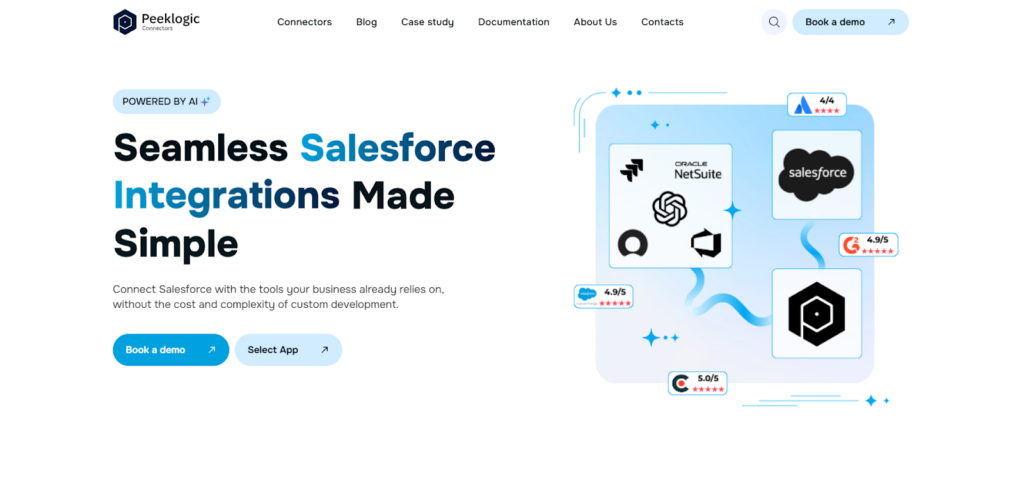
Peeklogic started as a Salesforce consulting partner. They spent years fixing broken custom integrations before deciding to build a product that wouldn’t break in the first place. Their Salesforce NetSuite Connector is designed to handle synchronization reliably without constant maintenance or custom fixes. The platform handles API changes behind the scenes, so business users don’t have to worry about version updates breaking their workflows.
What Makes This Integration Stable in Practice
Stability comes from how the tool handles failure, not just how well it works when everything runs smoothly. The platform includes error handling that retries failed syncs, logging that shows you what happened, and monitoring that alerts you before problems compound. Key features that support long-term stability include:
- Real-time bidirectional sync without scheduled delays;
- No-code setup reducing dependency on developers;
- AI-powered automation minimizing manual errors;
- Flexible field mapping that adapts to system changes;
- Fast deployment with minimal ongoing maintenance.
This combination means your integration keeps running when APIs change. Your team isn’t chasing broken scripts. Finance trusts the numbers because the sync doesn’t fail silently.
Who This Tool Is Actually Built For
Teams without dedicated developers choose Peeklogic because they can’t afford to maintain custom code. Fast-scaling companies benefit from reliability when deal volume grows. Organizations dealing with frequent API changes, like those on Salesforce or NetSuite release schedules, appreciate that the platform handles updates automatically.
2. Exalate
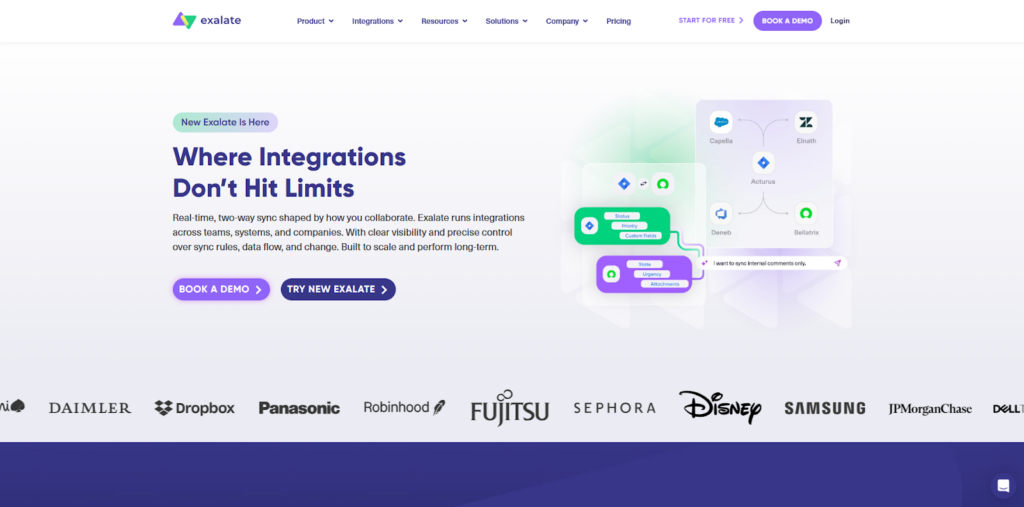
Exalate approaches stability through decentralization. Each system maintains its own instance and decides what to share. When one side updates its API, the other side doesn’t break because they’re not tightly coupled. This architecture handles failure better than point-to-point integrations.
Configuration happens through Groovy scripts. This gives you precise control but requires developers. The platform includes advanced error handling and retry logic that keeps data moving even when temporary failures occur. Key capabilities include:
- Script-based customization for precise control;
- Decentralized sync reducing system dependencies;
- Advanced error handling and retry logic;
- Cross-instance synchronization support;
- AI-assisted configuration tools.
Exalate stays stable because it’s built for complex environments where things change frequently. The trade-off is that you need developers to maintain the configuration.
3. ServiceRocket
ServiceRocket takes a different approach to stability. They don’t just sell software. They manage the integration for you. Implementation, monitoring, issue resolution, all handled by their team. For organizations where internal resources are limited, this model delivers reliability without requiring in-house expertise.
The company provides SLA-backed guarantees on uptime and response times. They handle migrations when you’re moving off legacy systems. They monitor sync health so you don’t have to. Key capabilities include:
- Managed implementation and support services;
- Custom integration tailored to existing systems;
- Ongoing monitoring and issue resolution;
- SLA-backed reliability guarantees;
- Migration support from legacy systems.
ServiceRocket makes sense when you need reliability but don’t have the team to manage it yourself.
4. Boomi
Boomi is one of those enterprise iPaaS things. Big companies use it when they can’t afford things to break. The platform handles tons of data without slowing down, which matters when you’re syncing thousands of Salesforce opportunities to NetSuite every day. If something fails during a sync, it retries. If retries don’t work, it dumps the failed record into a queue so you can see what happened. Pre-built connectors for Salesforce and NetSuite mean you’re not starting from scratch with field mappings.
Centralized monitoring dashboards show you sync health across all your integrations. When something fails, you see what happened and why. Key capabilities include:
- Enterprise iPaaS platform with a strong reliability focus;
- Pre-built connectors and templates;
- Error handling and retry mechanisms;
- Scalable architecture for high data volumes;
- Centralized monitoring dashboards.
Boomi works well for organizations running multiple integrations that need enterprise-level reliability.
5. MuleSoft
MuleSoft represents the enterprise end of the reliability spectrum. Their API-led architecture separates systems from each other, reducing the impact when one side changes. Anypoint Platform includes advanced monitoring, logging, and governance features that large organizations require.
For Salesforce NetSuite integration specifically, MuleSoft provides pre-built connectors and templates that handle the complexity of both systems. Error handling, retry logic, and data transformation happen within a governed framework. Key capabilities include:
- API-led integration architecture;
- High reliability for enterprise environments;
- Advanced monitoring and logging;
- Support for complex workflows;
- Strong governance and security features.
MuleSoft fits organizations where integration failures have a significant business impact and where governance requires formal approval and documentation.
How to Choose an Integration That Won’t Break
Feature lists distract from what actually matters for reliability. According to our analysts, most integration failures happen because organizations choose based on features rather than stability. To avoid integration failures, focus on:
- Whether the tool supports real-time sync without delays that create windows for data drift;
- Level of dependency on developers for maintenance when systems change;
- Availability of monitoring and error handling that alerts you before problems compound;
- Flexibility when APIs or data structures change without requiring reconfiguration;
- Long-term support and scalability as your transaction volume grows.
Start with what your team can actually maintain. A tool that requires developer attention you don’t have will break eventually. A tool without monitoring will break without you knowing.
Final Thoughts
Reliable integration isn’t about features. It’s about what happens when things go wrong. Peeklogic offers a balanced approach with no-code configuration and built-in error handling. Exalate provides stability through decentralization but requires developers. ServiceRocket manages reliability for you. Boomi and MuleSoft deliver enterprise-grade platforms with monitoring and governance.
Choose based on who will maintain it and how much tolerance you have for downtime. According to our data, the integration that doesn’t break is the one designed for the team that actually runs it.